Bowling Balls: The Most Important Decision
Your bowling ball is the single most important piece of equipment you own. The right ball, matched to your style and lane conditions, will make you more consistent and more effective than any other change you can make. The wrong ball — or a ball that doesn't fit your hand properly — holds back even skilled bowlers.
Ball Weight
Bowling balls range from 6 to 16 pounds. The maximum allowed weight for competition is 16 pounds. Most adults bowl with a ball between 14 and 16 pounds. The general guideline is to use the heaviest ball you can swing comfortably and consistently through an entire game (or several games) without fatigue.
Heavier balls carry more momentum into the pins, which results in better pin action (pins hitting other pins). A 16-pound ball striking the pocket cleanly is statistically more likely to produce a strike than a 12-pound ball, all else being equal. However, a lighter ball you can swing smoothly and consistently will outperform a heavy ball you're muscling.
Weight rule of thumb: Use roughly 10% of your body weight, up to 16 lbs. If you weigh 160 lbs or more, a 16 lb ball is appropriate if you can swing it comfortably. For younger players or those with physical limitations, go lighter without hesitation.
The Three Types of Coverstock
The coverstock is the outer shell of the bowling ball, and it determines how the ball interacts with the lane surface and oil. This is the most important factor in how much a ball hooks and when. There are four primary types:
Plastic (Polyester): The simplest and least expensive coverstock. Plastic balls are extremely smooth and have very little friction with the lane surface, producing a straight, predictable path. They are the ideal choice for beginners and for spare shooting (specifically for corner pins like the 10-pin, where hooking is a disadvantage). Every serious bowler should own at least one plastic spare ball.
Urethane: Introduced in the 1980s, urethane coverstocks create more friction than plastic, producing a smoother, more controlled hook. Urethane balls are less aggressive than reactive resin but more predictable and better suited to certain lane conditions — particularly low-volume oil patterns or older, dryer lanes. Urethane has seen a significant resurgence in competitive play in recent years.
Reactive Resin: The dominant technology in modern bowling. Reactive resin coverstocks were introduced in the early 1990s and transformed the sport. They create substantially more friction than urethane, especially in the dry part of the lane past the oil, producing strong, defined hook arcs. Most competitive bowlers use reactive resin as their primary strike ball. Reactive resin comes in three sub-categories: solid, pearl, and hybrid, each with slightly different motion characteristics.
Particle (Proactive): Reactive resin with small particles embedded in the coverstock for maximum friction. Primarily used on very oily conditions. Less common than it was in the early 2000s but still available.
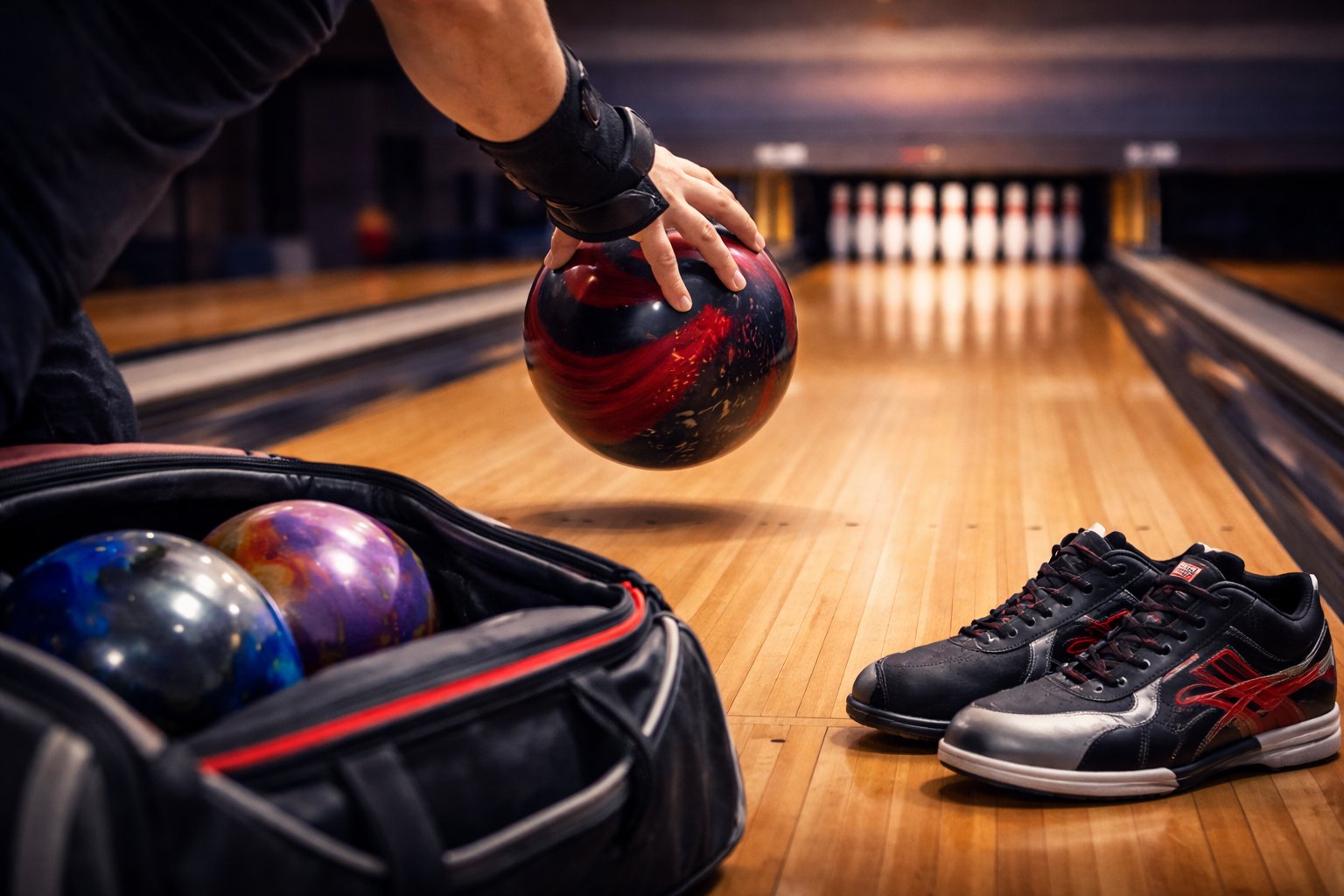
Understanding Ball Cores
Inside every bowling ball is a core — a weighted, shaped piece of dense material that determines the ball's mass distribution and, consequently, its flare potential, rev matching, and overall motion dynamics. Core design is one of the most technically complex aspects of modern bowling ball engineering.
Symmetrical vs. Asymmetrical Cores
Symmetrical cores have an even mass distribution around the ball's axis of symmetry. They produce a smoother, more predictable arc with consistent motion from the release through the breakpoint. Most beginner and intermediate balls feature symmetrical cores.
Asymmetrical cores have an uneven mass distribution, creating more differential between the ball's different axes. This produces a more dynamic, angular motion — the ball stores energy longer and then makes a sharper, more aggressive change of direction near the pins. Asymmetrical balls give advanced players more options to adjust their game by altering the pin position or drilling layouts.
Ball Layouts and Drilling
How a ball is drilled — where the finger holes are placed relative to the core's pin and mass bias — dramatically affects how the ball rolls. A "strong" layout (pin down, close to the fingers) produces early, smooth hook. A "weak" layout (pin up, further from the fingers) produces later, more angular motion. A skilled pro shop operator can drill a ball to match your rev rate, ball speed, and the lane conditions you bowl on most frequently.
Surface Preparation
The surface of your bowling ball degrades over time as it absorbs oil and picks up micro-scratches from the lane surface. Maintaining your ball's surface is crucial to preserving its performance. A ball that was aggressive when new can become lifeless after 30-40 games if the surface isn't maintained.
- Wipe after every shot: Use a microfiber towel to wipe oil off your ball after every delivery. This prevents oil from soaking deep into the coverstock.
- Abralon and sandpaper: Resurfacing with Abralon pads of specific grits changes the surface friction significantly. Lower grit (500-1000) makes the ball more aggressive; higher grit (2000-4000) makes it smoother. Polish can be applied over any grit to add additional length.
- Deep cleaning: Periodically (every 50-75 games), balls should be cleaned using a ball spinner and appropriate ball cleaner to remove oil that has penetrated below the surface.
Bowling Shoes
Proper bowling shoes are non-negotiable for serious play — and not just because bowling centers require them. Bowling shoes are specifically engineered for the slide that occurs during delivery. The slide foot (left foot for right-handers) has a smooth microfiber or leather sole that allows a controlled slide into the foul line. The non-slide foot has a rubber sole for traction.
Rental vs. Performance Shoes
Rental shoes provided by bowling centers are functional but limited. They typically have slide soles on both shoes, which means right-handed bowlers are sliding on the wrong foot too. They also wear out quickly from heavy use and provide no support for serious play.
Performance bowling shoes allow interchangeable heel and sole pieces. You can swap in different levels of slide on the slide foot and different braking materials on the non-slide foot depending on the approach surface at your bowling center. Entry-level performance shoes from brands like Dexter, Storm, and 3G start around $60-80, while high-performance options can exceed $200.
Bowling Bags
How you transport your equipment matters more than most bowlers realize — both for convenience and for keeping your balls in optimal condition. Bowling bags range from simple single-ball totes to rolling carts that carry six or more balls.
- Single ball bag: Perfect for recreational bowlers who own one ball. Shoulder bag or tote style. Inexpensive, easy to carry.
- Double ball bag: The minimum for any competitive bowler who wants to carry a strike ball and a spare ball. Many competitive players carry a third ball for different conditions.
- 3-6 ball roller: Rolling bags for serious league and tournament bowlers. Includes separate compartments for shoes, accessories, and personal items. Essential for anyone competing regularly.
Essential Accessories
Beyond balls, shoes, and bags, a range of smaller accessories can meaningfully improve your game and comfort:
Bowling glove or wrist support: Wrist devices help maintain consistent wrist position at release, particularly useful for players who struggle with wrist breaking through the shot. Brands like Robby's, Storm, and Master offer a wide range. Note that some advanced players avoid wrist devices to develop natural wrist strength.
Rosin bag: A small bag of rosin powder that helps with grip. Particularly useful if your hands tend to perspire. Available at any pro shop for a few dollars.
Microfiber towels: Essential for ball maintenance. Keep several in your bag. Wipe your ball after every shot, and use a dedicated towel for ball cleaning versus drying your hands.
Thumb tape: Competitive bowlers frequently use tape in the thumb hole to fine-tune their grip. White tape (smoother) reduces friction; brown/black tape (rougher) increases friction. Having both types lets you adjust to changes in humidity that affect your skin texture.
Ball spinner: A rotating stand that spins your ball so you can apply surface treatments (sandpaper, polish) evenly. Essential for serious players who maintain their own equipment.
Smart Buying Guide
For bowlers just getting started with their own equipment, here is the most practical approach to building your equipment collection progressively:
First purchase: Get fitted for and buy one reactive resin ball at a pro shop. Spend money on the fitting and drilling — a ball that fits your hand correctly matters far more than which ball you buy. Budget $100-200 total including drilling.
Second purchase: A plastic spare ball. Spend $50-80. Have it drilled the same as your strike ball for consistency.
Third purchase: A proper pair of performance shoes. Your rental shoe days are behind you. Budget $60-120.
Fourth purchase: A double ball bag, a wrist support if needed, and accessories. Budget $60-100.
Total to be properly equipped for competitive recreational play: $350-500. That's a one-time investment that will serve you for years with proper maintenance.
Pro shop vs. online: We strongly recommend buying your first bowling ball at a physical pro shop and having it fitted in person. The fitting and drilling are as important as the ball itself — an improperly drilled ball will hurt your game regardless of how good the ball is. Once you know your measurements, online purchasing makes more sense for subsequent balls.