What Is Lane Oil and Why Does It Exist?
Lane oil — technically called lane conditioner — is a mineral oil-based substance applied to the surface of a bowling lane before play. It serves two primary purposes: protecting the lane surface from the friction and impact of bowling balls (which would otherwise wear down the lane extremely quickly), and creating the specific playing condition that defines the game.
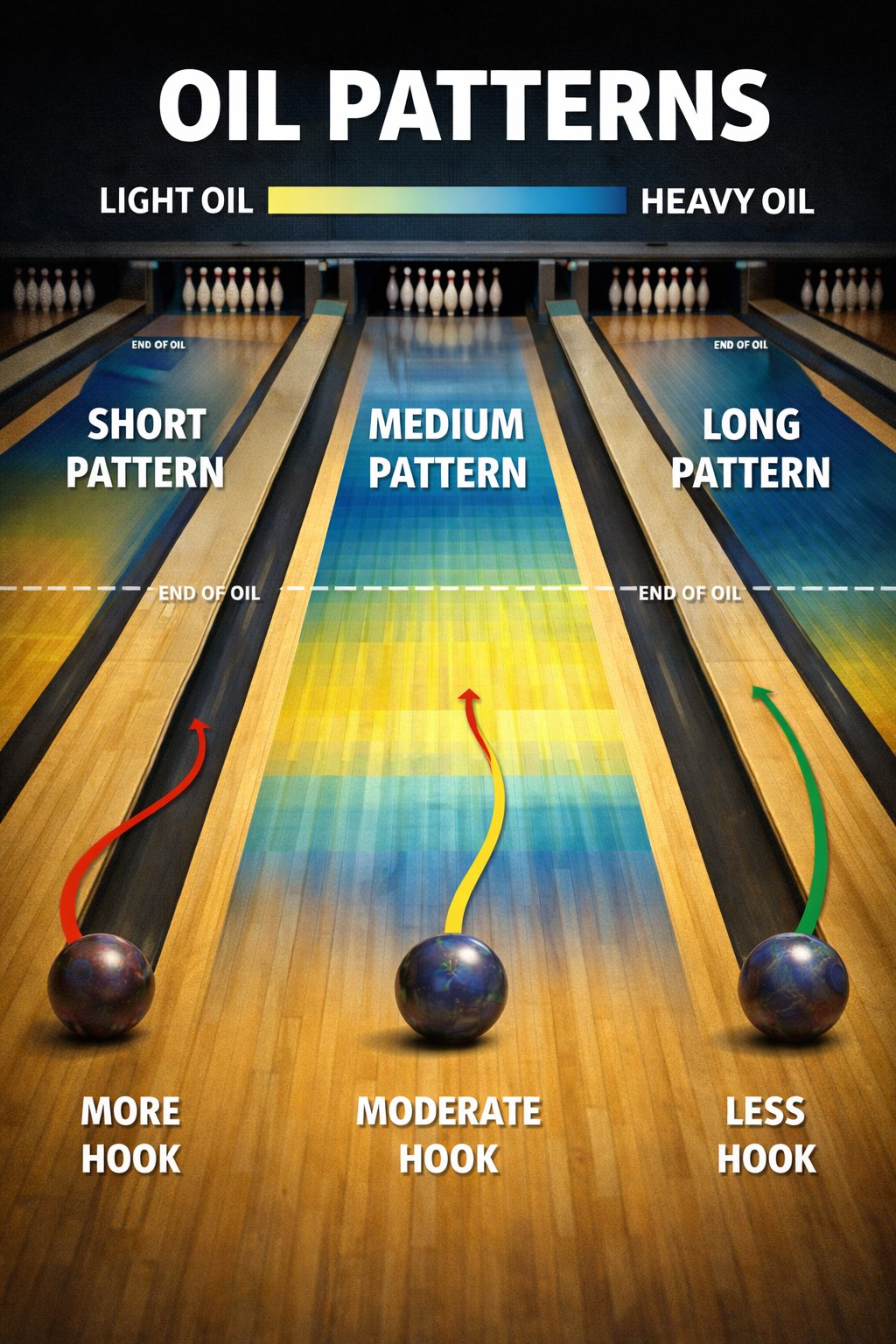
Without lane oil, bowling balls would hook dramatically on every delivery, making the sport nearly unplayable. The oil creates a low-friction zone that allows the ball to slide and retain energy before the ball transitions to the dry area of the lane, where friction causes it to change direction (hook) toward the pins.
Every time a ball rolls over an oiled portion of the lane, it carries some oil with it — either pushing it further down the lane (called "carry-down") or displacing it to the sides. The ball also absorbs some oil into its coverstock. This means the pattern is constantly evolving throughout a bowling session, and bowlers must continuously read and react to changing conditions.
Key concept: Lane oil is not applied uniformly. It is applied in a specific pattern — defined by volume, length, and lateral distribution — that creates the playing condition. Understanding these patterns is what gives advanced bowlers a massive advantage over less informed competitors.
How Oil Patterns Are Applied
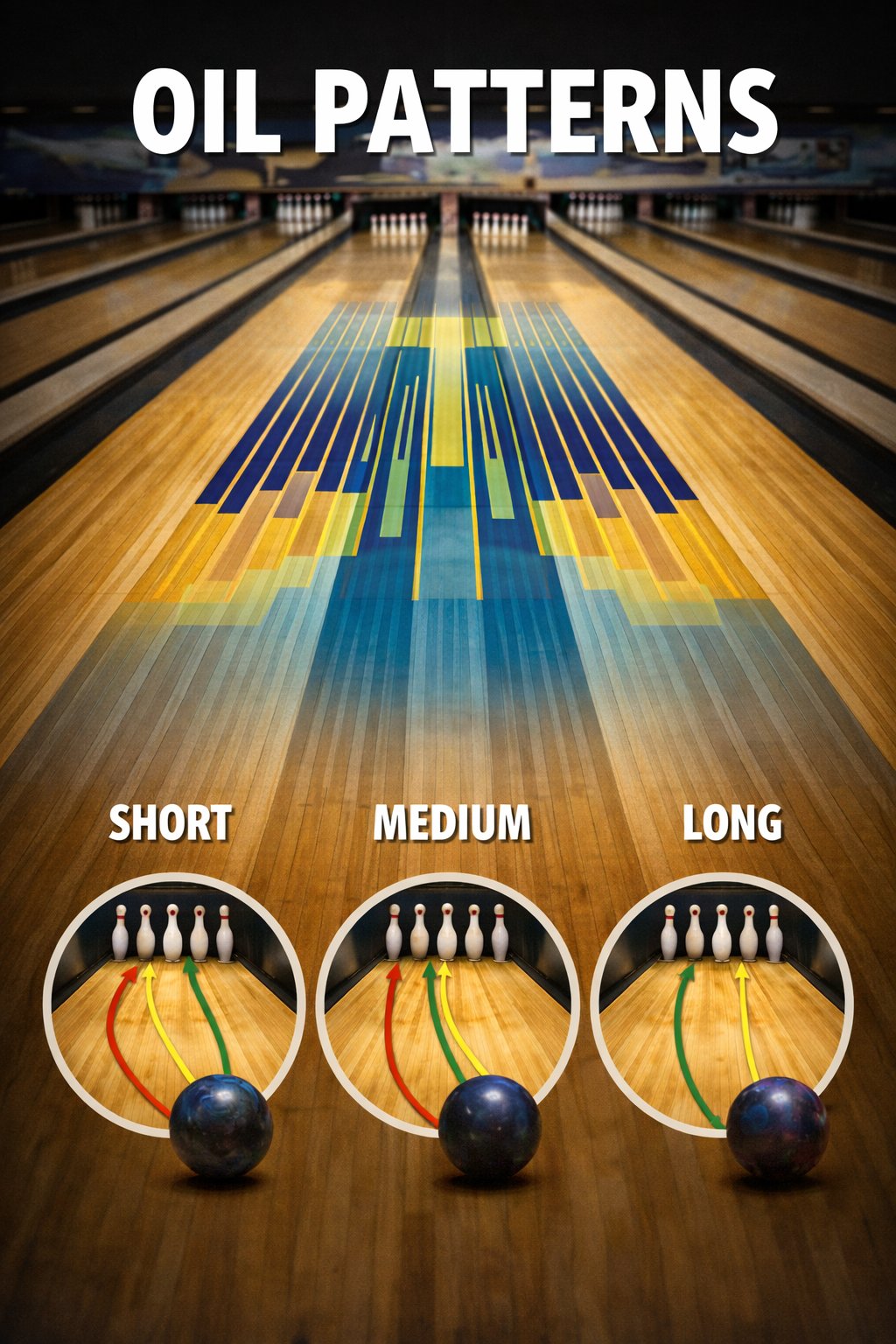
Modern bowling centers use computerized lane machines to apply oil with extraordinary precision. These machines move along the lane applying oil in programmed patterns, controlling the amount of oil applied to each board (there are 39 boards across the width of a bowling lane, numbered 1-39 from right to left for right-handed bowlers), and precisely where along the lane length the oil starts and stops.
The key parameters of any oil pattern are:
- Length: How far down the lane the oil extends (typically 30-45 feet). Shorter patterns are generally more challenging.
- Volume: How much total oil is applied (measured in microliters). Higher volume means more oil and less friction.
- Load: How the oil is distributed across the boards, creating stronger or weaker sections.
- Forward vs. reverse passes: Lane machines make multiple passes. Forward passes apply oil; some patterns use "reverse" passes (wiping) to create specific shapes.
House Patterns: The Recreational Standard
A "house pattern" is the standard oil pattern applied at recreational bowling centers for league and open play. House patterns are deliberately engineered to be forgiving — they are designed to make the game more enjoyable for recreational bowlers by helping balls find the pocket even on imperfect shots.
The "Inverted Triangle" Shape
The defining characteristic of a house pattern is what's often called the "inverted triangle" shape — there is significantly more oil in the middle of the lane (boards 10-30) than on the outside boards (1-9). This creates a natural funnel effect: a ball thrown too far to the outside (toward the gutter) will encounter dry boards and hook back toward the center and the pocket. A ball thrown too far inside will stay on the oily center and slide past the pocket, but typically only misses slightly.
This is why recreational bowlers who throw a hook tend to average much higher on house conditions than on competitive patterns. The lane is effectively helping you hit the pocket. High averages on house conditions don't necessarily translate to competitive environments — a fact that surprises many bowlers the first time they bowl on sport conditions.
Typical House Pattern Specs
While house patterns vary by bowling center, typical characteristics include: 40-42 feet in length, moderate volume (20-25 microliters), with 3-4 times more oil in the middle third of the lane than on the outside boards. The USBC recommends specific house pattern ratios to maintain consistent recreational conditions across its member centers.
Sport Patterns: The Competitive Challenge
Sport patterns — also called "sport bowling conditions" — are oil patterns that meet the USBC Sport Bowling specifications. These patterns level the playing field by removing the built-in advantage of house patterns. They are used in competitive tournaments, Sport Bowling leagues, and official competitions at all levels from regional to the PBA Tour.
What Makes Sport Patterns Different
The USBC requires that sport patterns have a ratio of no more than 3:1 between the most-oiled boards and the least-oiled boards across the lane width. Compare this to typical house patterns with ratios of 8:1 or higher — the difference is dramatic. On a sport pattern, there is very little margin for error. A ball slightly off your target line won't be corrected by the pattern; it will simply miss the pocket.
Sport patterns also tend to be shorter in length (36-42 feet is typical for PBA-style patterns, though this varies enormously) and involve more complex shapes that can't be described with a simple phrase. Reading the pattern sheet and figuring out where to play is itself a significant skill.
Major PBA Tour Patterns
The PBA Tour uses a rotating set of named oil patterns for its events, each presenting different challenges. Some of the most notable:
- Cheetah (33 feet): One of the shortest PBA animal patterns, it demands precision angle play and rewards accuracy over power. Bowlers must be careful not to overthrow the breakpoint.
- Shark (44.5 feet): One of the longer and more complex patterns, Shark traditionally favors higher rev rate bowlers who can generate strong down-lane motion.
- Scorpion (42 feet): A moderately long pattern with significant outside oil depletion as games progress. Creates multiple feasible lines but punishes inconsistency severely.
- Viper (37 feet): A medium-length pattern that tests both precision and power game. Creates pronounced track depletion and requires significant adjustment over a tournament.
- Chameleon (39 feet): The most "chameleon-like" of the PBA patterns, requiring bowlers to identify and exploit the specific line available early and adapt quickly as conditions break down.
The animal patterns: The five PBA animal patterns — Cheetah, Scorpion, Shark, Viper, and Chameleon — have been used in PBA competition for decades. Players accumulate titles on each animal, with achieving at least one title on all five being considered a significant milestone called completing the "super slam."
Reading the Lane: Practical Skills
You can't see oil on a bowling lane during play (though it can sometimes be detected by reflected light). Reading oil conditions requires observation, reasoning, and experience. Here are the main skills competitive bowlers develop:
Reading Your Ball Motion
The most direct information about lane conditions comes from watching your ball. Where does it start to change direction? How sharp is the hook? Is it consistent from shot to shot? Answers to these questions tell you where the oil ends, how the pattern is shaped, and whether conditions are changing.
- Ball hooks early → the transition zone (where oil ends) is closer to the foul line; the lane may be burning up in that area
- Ball hooks late or not at all → heavy oil is carrying further down; you need more friction or a more aggressive angle
- Ball overshoots the pocket to the weak side → you're in a heavier oil track; move toward drier boards
- Ball hooks before the breakpoint → you're on a dry area; move toward more oil or use a weaker ball
Using the Pattern Sheet
In competitive bowling, the pattern sheet is published before competition begins. It shows the exact oil distribution across all boards, at every foot mark, for the full length of the pattern. Learning to read a pattern sheet takes practice, but it enables you to form a starting strategy before you throw a single ball in practice.
Key things to identify on a pattern sheet: where is the strongest oil (heaviest volume)? Where is the oil boundary (the transition from oiled to dry)? How sharp is that boundary? Does the pattern taper laterally, or is it relatively uniform? Answers to these questions suggest where to stand, where to target, and which ball to throw first.
Adjusting During Competition
Lane conditions change as oil migrates. The three primary adjustments available to any bowler are: move your feet, move your target, or change equipment. Understanding when to do which — and by how much — is the core skill of competitive bowling strategy.
The general progression: if the ball is hooking too much, move toward more oil (typically move your feet toward the center without moving your target, effectively moving to a more direct line). If the ball isn't hooking enough, move toward drier boards or use more friction on the ball surface. If conditions have broken down beyond adjustment through feet and eyes, a ball change may be necessary.
Oil Depletion and Track Marks
As games are bowled on a lane, oil migrates and depletes. Most right-handed bowlers throw their balls in a relatively similar path, creating what's called a "track" — a worn, depleted zone where the oil has been pushed aside or absorbed. This track typically runs between the 10-board and 20-board range on most house conditions.
As the track burns down, bowlers who were playing in that zone need to move — either further inside (toward the center) to find fresh oil, or further outside to play the now-dry boards at a sharper angle. The ability to identify track migration early and adjust proactively — rather than reactively after missing shots — is a significant competitive advantage.
Blocked vs. Flat Patterns
Beyond house and sport patterns, oil patterns can be categorized on a spectrum from "blocked" to "flat." A blocked pattern has extreme side-to-side oil variation (lots of oil in the middle, very little outside) — the most extreme form of the house pattern principle. A flat pattern has uniform oil distribution across the entire lane width, providing no assistance and maximum difficulty.
Most bowling center patterns fall somewhere between these extremes. Sport patterns approach flat. True flat patterns are rare outside of specific challenge events. Understanding where on this spectrum your conditions fall helps you calibrate your game plan appropriately.
Adapting Your Game to Different Conditions
Being a versatile bowler — one who can compete effectively on multiple types of conditions — is the highest skill level in bowling. It requires the right equipment arsenal, strong fundamental mechanics, and deep pattern-reading experience. Here's how to approach the most common scenario types:
Long, heavy patterns: Play more direct angles. Use stronger coverstocks with more surface. Let the ball length work for you — don't over-hook it.
Short, dry patterns: Use weaker coverstock (urethane or polished reactive). Play outside angles. Keep ball speed up to control the amount of hook.
Burned-down house patterns (late in a long block): Move toward the center as outside oil depletes. High rev players may be able to play deeper angles; accuracy players may benefit from moving straighter to avoid the burned track.
Sport conditions (flat patterns): Precision above all else. Every small mistake is amplified. Focus on repeating your best shots, not trying to be aggressive. Consistent execution on a moderate line beats a flashy line you can't repeat.